Your dog’s first day at daycare: what to expect, visit by visit
The short answer: plenty of dogs don’t play on Day 1. They sniff, watch, find a spot they like and take in the room, and that’s a healthy first day. Comfort often comes on the second visit, and by the third many dogs have a favorite friend, a favorite spot to rest, or both. If your dog spends Day 1 watching from the sidelines, nothing is wrong.
We’ve been introducing new dogs to the pack since 2011, at McCarren Park, Waterfront, 23rd and 1st and Long Island City. Here’s what the first three visits usually look like from our side of the room, and what we’re watching for.
Before Day 1
When you register, you tell us about your dog: how they are with other dogs, their energy, anything that worries you. On Day 1 your dog doesn’t get dropped into a room of strangers. Every dog starts with a careful introduction to the group, not a free-for-all, and we’re asking one question: is group play fun for your dog, and which group fits? Active dogs play with dogs who play like they do; laid-back dogs get a calmer room.
If you’re comparing daycares anywhere in NYC, ask each one: “What does my dog’s first day actually look like?”
Day 1: is it normal if my dog just watches?
Yes. It’s one of the most common first days we see.
Within the first hour we usually know which of a few broad styles we’re working with.
The watcher. Calm, happy to share space, not looking for a wrestling partner. Watchers spend Day 1 finding their spots and trading polite sniffs when another dog says hello. Some stay watchers, and still love daycare without ever roughhousing. Being with the pack is the point for them.
The social butterfly. Tail going, greeting everyone, playing within the hour. For these dogs our job runs the other way: making sure they take breaks and drink water.
The people dog. More interested in our staff than the other dogs: leaning on legs, following us around. Often these dogs branch out to dog friends once the people feel like home base.
The slow-to-warm dog. A little unsure, maybe startled when play bursts out across the room. We let these dogs set the pace. Watching one choose, in their own time, to step toward the group is one of the best parts of the job.
What we’re looking for on Day 1 isn’t play. It’s a loose body, curiosity, bouncing back after a startle, and any small choice to engage: a sniff, a step closer, a wag at a passing dog.
After Day 1: why is my dog so tired?
Expect a sleepy dog tonight. Even a dog who mostly watched has spent hours taking in new smells, dogs, people and sounds, and that’s tiring work. Dinner, then deep sleep, is normal.
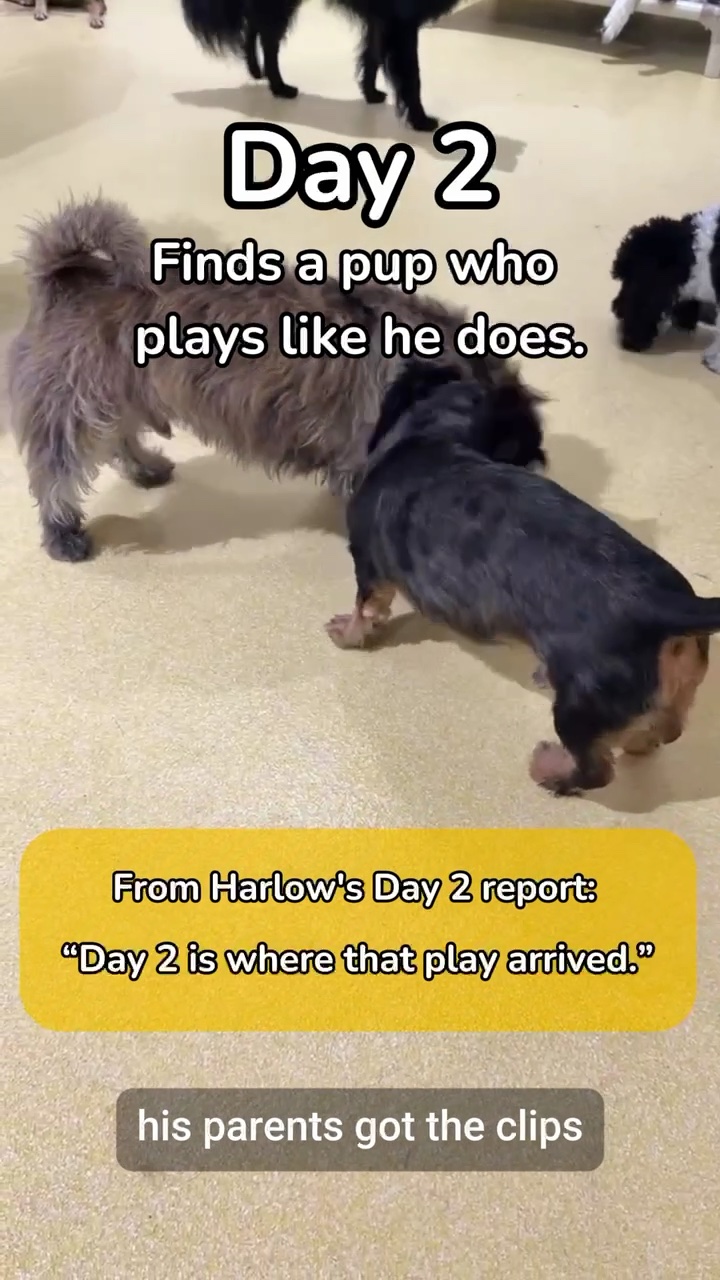
Day 2: when the room stops being new
Your dog walks in and recognizes the space, the staff and some of the dogs, and that recognition makes a big difference.
This is the visit where we most often see firsts: the first play bow, the first game of chase, the first friend. What we’re watching for is play that goes both ways: both dogs taking turns chasing, both coming back for more after a break.
For a watcher, Day 2 looks quieter: less time near the door, more relaxed lounging, a spot a little closer to the group. “He stopped watching the exit” doesn’t sound like much, but for that dog it’s a real step.
For a social butterfly, Day 2 is often the biggest-energy day of the three.
Day 3: why a calmer day is a good sign
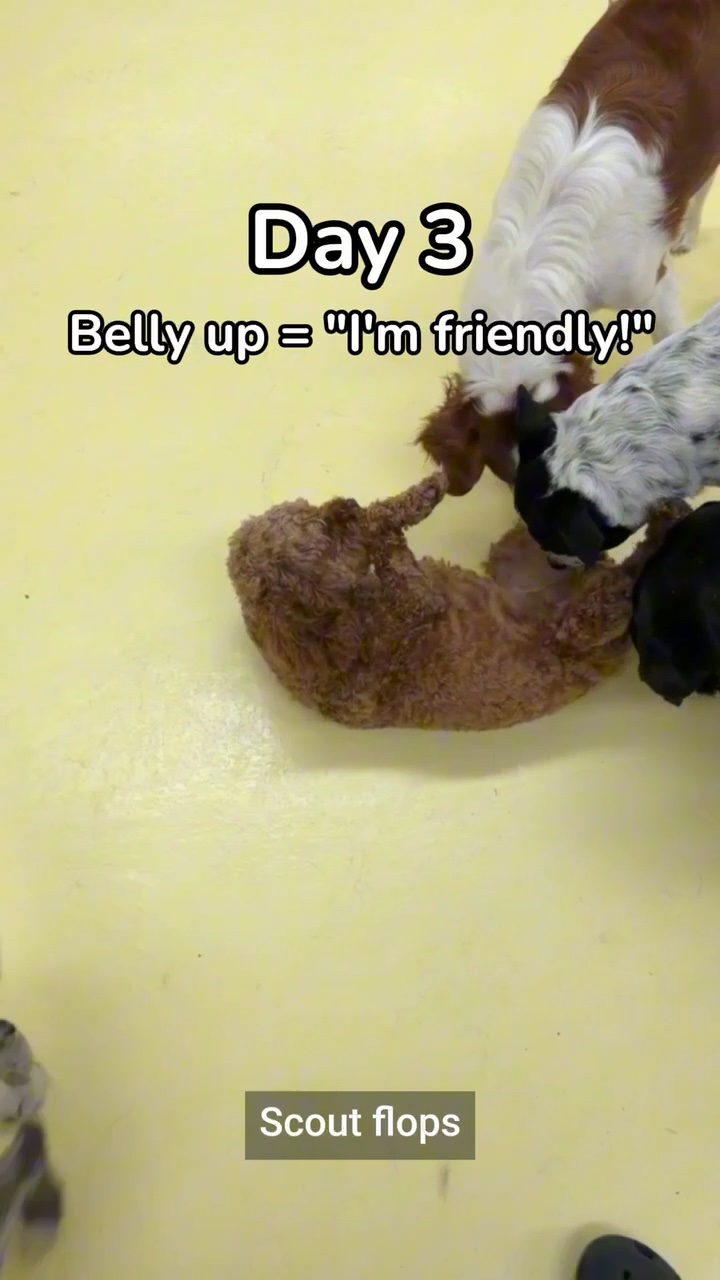
Some dogs finish Day 3 at full speed, inseparable from a new friend. But many high-energy dogs have a noticeably calmer third day. They play with their favorite friend for a while, then get up on a cot and watch the room for an hour.
We like seeing that. A dog who dived into everything on Days 1 and 2 and then settles into play, rest and watching on Day 3 is regulating their own energy, which is what a dog who feels at home here does.
And the dog who watched politely all three days and never joined a wrestling match? If they’re relaxed, sharing space happily and greeting politely, that’s a good start too. Watchers often open up as the faces become familiar, in their own time.
What you’ll hear from us
On Day 1 you’ll get text updates through the day on how your dog is doing, and an update after each visit. In Foundations, you also get an email from one of the owners after each of the three days, often with photos or a video, a Compare Notes call with an owner, and a graduation on Day 3. And you can always text or call us at 917-512-2828, or watch for yourself on the live cam.
When you look at the photos and videos, look past “did they play?” Is their body loose or stiff? Are they choosing to be near the group? Is the same friend showing up again? From cautious to curious to comfortable is a good three days, at any energy level.
A note for NYC dogs
Most of our dogs live in apartments without backyards and meet other dogs at crowded dog parks, where nobody is managing the play. For many, daycare is the first time they’ve had off-leash company with people reading the room the whole time. Some dogs who don’t do well at the dog park do well here for exactly that reason: the group is matched, and someone is always watching the play.
Questions parents ask
How long does it take a dog to settle in at daycare?
Many dogs are visibly more comfortable by their second visit and have a rhythm by their third. Favorite friends and confident routines usually build over the first few weeks of regular visits.
My dog didn’t play at all on the first day. Should I worry?
No. Watching without playing is one of the most common first days we see. What would concern us is distress that doesn’t ease: pacing, not bouncing back after a startle. If we saw that, we’d tell you and talk it through with you, not push on.
What if my dog is shy or nervous around other dogs?
Tell us when you register. We’ll let your dog set the pace. Many of our happiest regulars started out by the door.
What if daycare isn’t a good fit for my dog?
We’ll tell you honestly. Some dogs are happier with one-on-one time, and pushing a dog who doesn’t enjoy the group helps no one. If that’s your dog, we’ll talk through what would suit them, such as a one-on-one Training Walk with the owner of Happy Dogs.